
Ragdoll Colours & Patterns: A Singapore Buyer’s Visual Guide
Ragdoll colours and patterns in Singapore explained: seal vs blue point, mitted vs bicolor, rarest lilac & chocolate, lynx & mink, plus colour-change.
Ask two Singapore owners to describe “a Ragdoll” and you will get two completely different cats — one a smoky blue-grey, the other a rich seal with snowy mittens. That variety is exactly why understanding Ragdoll colours and patterns in Singapore matters so much before you choose a kitten. A Ragdoll’s coat is a layered code of pattern, colour, and marking, and learning to read it helps you picture the cat you’ll share your HDB flat or condo with for the next fifteen-plus years. As an AVS-licensed cattery raising Ragdolls here in Singapore, this is the question we field more than almost any other — so here is the complete, honest guide.
Ragdoll colours and patterns at a glance
- Three core patterns: colourpoint (no white), mitted (white paws, chin and belly stripe), and bicolor (white inverted-V face).
- Six colours: seal, blue, chocolate and lilac — plus the warmer red (flame) and cream.
- Two add-on variations: lynx (tabby stripes) and tortie (mottled), which can sit on top of any colour and pattern.
- Rarest colours are lilac and chocolate; seal and blue point are the most popular in Singapore.
- Every Ragdoll is born pure white — colour develops over the first weeks and full depth takes up to two years.
- Colour and pattern change the look, never the temperament — every Ragdoll shares the same gentle, floppy, people-loving nature.
In this article9 sections
- Ragdoll colours and patterns in Singapore: how the coat works
- The three Ragdoll patterns: bicolor vs mitted vs colourpoint
- Ragdoll colours, from seal to lilac
- Lynx, tortie and mink: the variations that change the look
- Do Ragdoll kittens change colour as they grow?
- Does colour affect personality or value?
- How to choose your Ragdoll colour and pattern
- Frequently asked questions
- Join the waitlist
Ragdoll colours and patterns in Singapore: how the coat works
The Ragdoll coat works in three layers, and once you see it this way the jargon falls into place. First comes the pattern — where the white sits on the body. Then the colour — the shade of the points and saddle. Finally an optional variation — lynx or tortie markings laid over the top. Stack those three together and you get names like “blue lynx bicolor” or “seal tortie mitted.” They sound elaborate, but each word is just describing one of the three layers. Get the layers, and you can decode any Ragdoll colours and patterns chart you ever meet.
The three Ragdoll patterns: bicolor vs mitted vs colourpoint
Pattern is the easiest place to start, because it is the first thing your eye lands on. It is purely about how much white the cat carries — from none at all to a bold masked face.
Colourpoint
The classic Siamese-style look: a pale body with darker points on the ears, face mask, legs and tail, and no white anywhere. The highest contrast of the three, and those famous deep-blue eyes pop against the dark mask.
Mitted
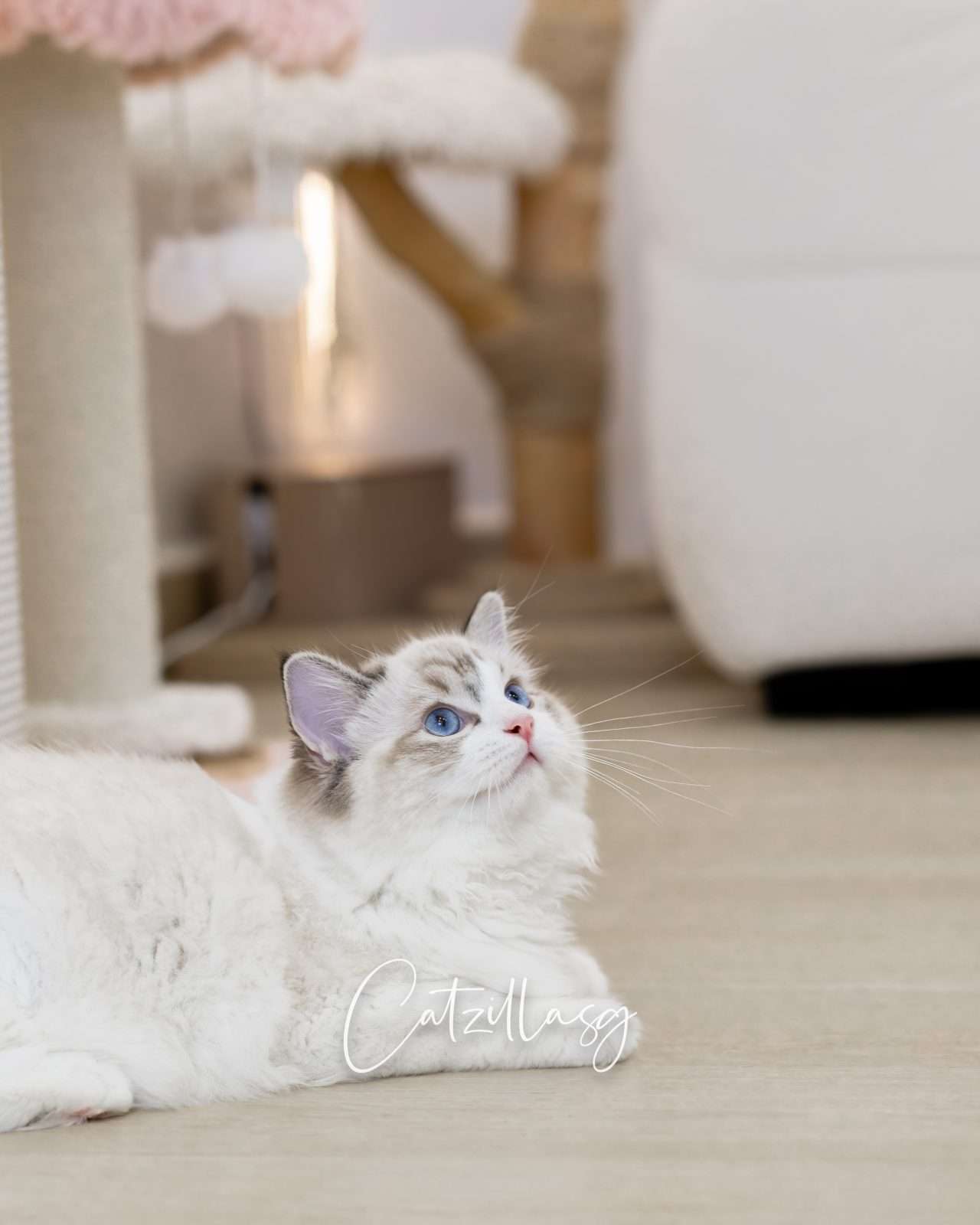
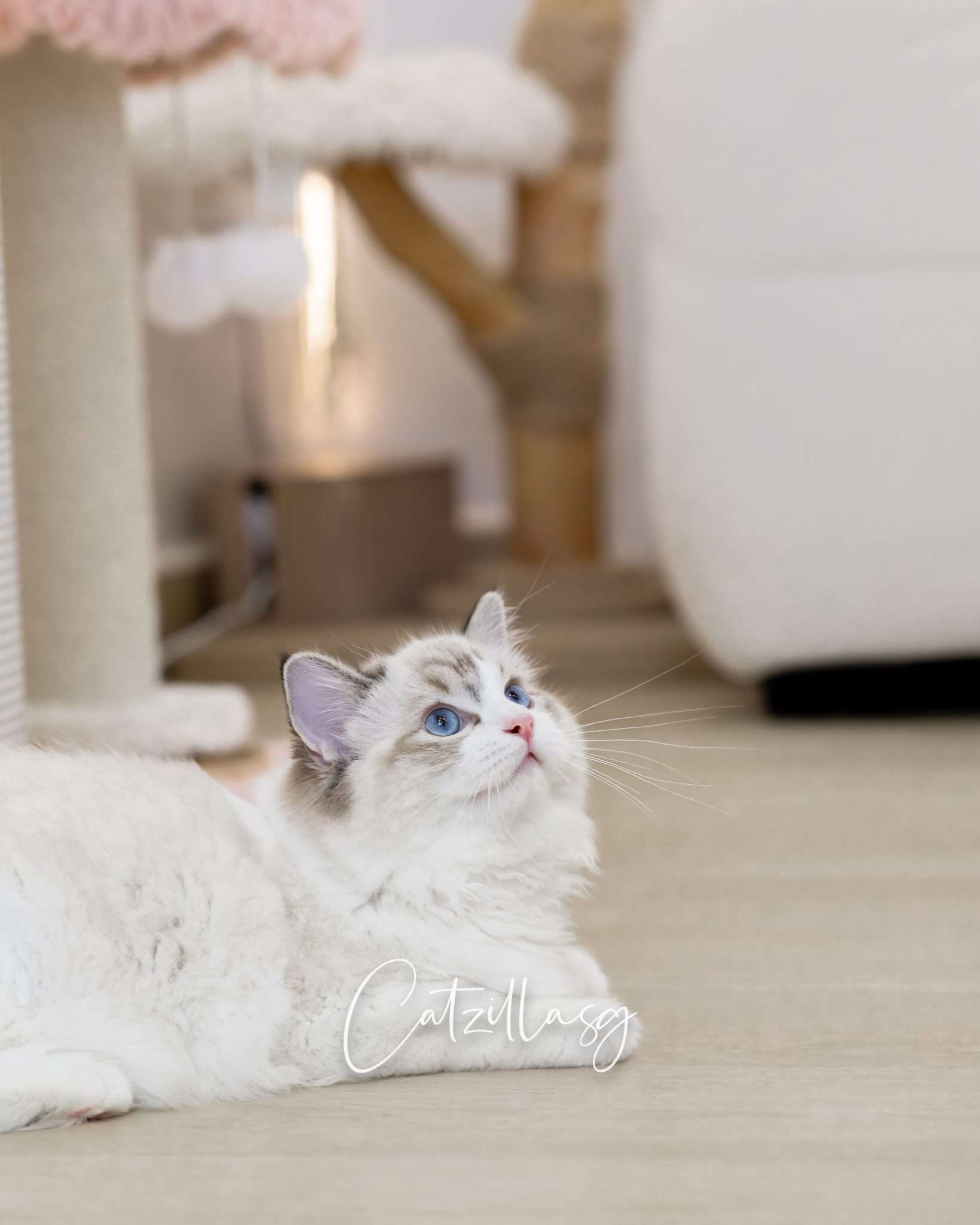
The same pointed colouring, but with crisp white mittens on the front paws, white boots up the back legs, a white chin and a belly stripe. Many mitteds also wear a white blaze on the nose. Tidy, symmetrical, beloved.
Bicolor
The whitest of the three: an inverted white V across the face, white legs, a white underbody, and a coloured “saddle” over the back. The softest, most open expression, and one of the most in-demand patterns in Singapore.
So the short answer to mitted vs bicolor vs colourpoint is simply white placement: colourpoint has none, mitted adds tidy white feet and chin, and bicolor opens the face up with that signature V. None is “better” — it is purely the expression you fall for.
White on a Ragdoll should look clean and patterned, not random or splashed. Strays of white in odd places (a stray toe of colour on a mitten, an uneven V) are common and charming, but extreme mismarking can be a sign of less careful breeding. When you meet our kittens, we will happily talk you through each one’s exact markings.
Ragdoll colours, from seal to lilac
Once you have settled on a pattern, colour is the shade of those points and that saddle. Ragdolls carry four traditional colours plus two warmer ones — and yes, we will spell “colors” the American way once or twice too, since plenty of you searching from Singapore type it both ways.
| Colour | What it looks like | How common in SG |
|---|---|---|
| Seal | Deep warm brown points — the classic, highest-contrast Ragdoll. | Most popular |
| Blue | Soft slate-grey points over a cool, smoky body. A perennial favourite here. | Most popular |
| Chocolate | Lighter, milk-chocolate brown — more delicate and noticeably rarer than seal. | Rare |
| Lilac | Pale frosty grey with a pinkish, dove-like tone. The softest and rarest of the four. | Rarest |
| Red (flame) | Warm orange points — bright, cheerful and uncommon. | Uncommon |
| Cream | A diluted, buttery version of red. Very pale and gentle. | Uncommon |
Seal point vs blue point Ragdoll: what is the difference?
This is the comparison we are asked for most, because seal and blue are the two you will see most often in Singapore. A seal point Ragdoll has deep, warm brown points and a creamy body — dramatic, high contrast, the “textbook” Ragdoll most people picture. A blue point Ragdoll is the dilute version of seal: the same gene, softened to a cool slate-grey point over a bluish-white body. Side by side, seal reads as warm and bold; blue reads as cool, smoky and gentle. In our humid local light, blues photograph beautifully and seals show off their contrast — honestly, you cannot go wrong, and many owners only decide once they have held both.
What is the rarest Ragdoll colour?
The rarest Ragdoll colours are lilac and chocolate. Both depend on recessive genes carried by both parents, so fewer are born in any given litter — lilac (a frosty pinkish-grey) being the scarcest of all. They are stunning, but rarity is the reason they appear less often on availability lists, not a sign of superior quality. Conversely, the most popular Ragdoll colour in Singapore is a near tie between seal and blue, simply because they are the most striking and the most familiar.
Be wary of any seller using an unusual colour name to justify a suspiciously high — or suspiciously cheap — price, or inventing colours that don’t exist in the breed standard. A genuinely rare lilac from health-tested, HCM- and PKD-screened parents is one thing; a “rare” label slapped on a backyard-bred kitten with no pedigree or vet records is a red flag. Colour is the fun part of the decision — health and ethical breeding should always come first.
Lynx, tortie and mink: the variations that change the look
On top of pattern and colour sit a few markings that transform a Ragdoll’s look. Two are the classic add-on variations — lynx and tortie — and a third, mink, is a coat type you will hear about often in Singapore.
Lynx adds tabby pencil-stripes to the points and a fine “eyeliner” rim around the eyes, giving a wilder, more detailed face. A lynx Ragdoll pattern can sit on any colour — a blue lynx bicolor or seal lynx mitted are real, specific combinations. Tortie blends red or cream into the base colour for a mottled, marbled effect, and is almost always female.
You will also hear about mink Ragdolls. A mink Ragdoll is born with colour already showing (rather than pure white), has a richer overall body tone, and aqua-green to blue-green eyes instead of the classic deep blue. Minks are gorgeous and increasingly sought after, though traditionalists note they fall outside the original pointed standard. Either way, mink, lynx or tortie all stack onto the same three-layer system — just more beautiful detail to read.
Do Ragdoll kittens change colour as they grow?
Yes — and it is one of the loveliest quirks of the breed. Every Ragdoll is born pure white. The points and saddle begin to develop over the first days and weeks, deepening steadily as the kitten grows, and the coat does not reach its full, rich depth until the cat is around two years old. So Ragdoll kitten colour change is completely normal: the kitten you meet at our cattery will keep blooming into its colour long after it comes home with you. Singapore’s warm, humid climate can also nudge points a touch lighter over a lifetime, since point colour responds to body temperature — a gentle, natural shift, never a flaw.
Because colour is still developing, judge a young kitten on its pattern (white placement is set early and reliable) and on its health and temperament — not on how saturated the points already look. A pale eight-week-old seal will mature into a dramatic adult.
Does colour affect personality or value?
Personality — no, not at all. This is the single most important thing to understand. A Ragdoll’s gentle, go-limp-in-your-arms, follow-you-from-room-to-room nature comes from the breed itself, not the shade of its coat. A lilac bicolor and a seal colourpoint will both flop into your lap exactly the same way.
Value — sometimes, a little. Rarer colours like lilac and chocolate can sit at the higher end simply because fewer are born. But the real drivers of a kitten’s value are health testing (HCM and PKD screening of the parents), pedigree, early socialisation, and how it is raised — not its colour. At CatzillaSG every Ragdoll comes from health-tested parents, goes home at a proper 12–16 weeks, is backed by a lifetime health guarantee, and you are always welcome to meet the mum. That foundation matters far more than whether the points are seal or blue.
How to choose your Ragdoll colour and pattern
With so many combinations, it helps to narrow down in this order:
- Pattern first — decide how much white you love: none (colourpoint), tidy mittens (mitted), or the open bicolor V.
- Then colour — high-contrast seal, cool blue, or a rarer lilac or chocolate.
- Then variation — whether lynx stripes, a tortie marble, or a mink’s warmth appeals.
- Always last, the kitten itself — health, socialisation and the bond you feel in person matter more than any colour chart.
If you are new to the breed, start with our complete Ragdoll in Singapore guide for temperament and care, browse our Ragdoll kittens in Singapore, then read before you get a Ragdoll for the practical realities of HDB and condo living with one. When you are ready, come and see the colours in real, local light — it is completely different from photos.
Frequently asked questions
What colours and patterns do Ragdoll cats come in?
Ragdolls come in three core patterns — colourpoint (no white), mitted (white paws, chin and belly stripe) and bicolor (white inverted-V face) — across six colours: seal, blue, chocolate, lilac, red (flame) and cream. Two variations, lynx (tabby stripes) and tortie (mottled), can layer onto any colour and pattern.
What is the most popular Ragdoll colour in Singapore?
Seal and blue are the most popular Ragdoll colours in Singapore. Seal offers bold, warm contrast while blue gives a cooler, smoky, gentle look — and both photograph beautifully in our local light.
What is the rarest Ragdoll colour?
Lilac is the rarest Ragdoll colour, followed by chocolate. Both rely on recessive genes that must be carried by both parents, so fewer are born — which is why they appear less often on availability lists.
What is the difference between a seal point and blue point Ragdoll?
A seal point Ragdoll has deep warm brown points and a creamy body for high contrast. A blue point Ragdoll is the dilute version — the same gene softened to cool slate-grey points over a bluish-white body, for a gentler, smokier look.
What is the difference between mitted, bicolor and colourpoint Ragdolls?
It is all about white placement. Colourpoint has no white at all; mitted adds white mittens, boots, chin and a belly stripe; bicolor is the whitest, with an inverted white V across the face plus white legs and underbody.
Do Ragdoll kittens change colour as they grow?
Yes. Every Ragdoll is born pure white, develops its points over the first weeks, and does not reach full coat depth until around two years old. So a pale young kitten will keep deepening into its adult colour long after it comes home.
Found the colour you love? See the current Ragdoll kittens available in Singapore.
See our Ragdoll colours and patterns in person
Meet the seal, blue, lilac and bicolor Ragdolls at our AVS-licensed Singapore cattery — from health-tested, HCM- and PKD-screened parents — and see how different each one looks in real light.